
80%

Available for select engagements · Q4 2026

I build the ops layer that makes Marketing and Sales teams successful at scale.

CRM architecture, AI-driven automation, and the operational systems that turn strategy into pipeline. Built across financial services, SaaS, and high-growth tech.

10+
years in operations
7+
years in MarTech
50-90%
ops reduction delivered

Knowledge and Skills — Delano Fernando

MarTech, MarOps and RevOps consultant. Practice areas, tools, professional skills, credentials, and case studies.

Domains of Practice

  • Marketing Operations
  • Revenue Operations
  • AI Automation
  • Data Architecture
  • Systems Design
  • Technical Builds

Professional Skills

  • Leadership
  • Problem Solving
  • Stakeholder Management
  • Strategic Thinking
  • Client Strategy
  • Digital Marketing
  • Analytical Thinking
  • Solution Design

Academic Credentials

  • MBA · Postgraduate Institute of Management, University of Sri Jayewardenepura
  • BSc (Hons) Computing Information Systems · First Class · University of Greenwich, UK
  • Higher National Diploma in Computing (Software Engineering) · Pearson Edexcel

Tools and Platforms

  • HubSpot
  • Salesforce
  • Marketo
  • Outreach
  • Salesloft
  • Marketing Cloud
  • Segment
  • Slack
  • n8n
  • Zapier
  • Intercom
  • Zendesk
  • Python
  • TypeScript
  • Node.js
  • Next.js
  • Astro
  • Tailwind CSS
  • Anthropic (Claude)
  • Google Gemini
  • Perplexity
  • Cursor
  • Pinecone
  • Postgres
  • Snowflake
  • BigQuery
  • dbt
  • SQL
  • Airflow
  • Fivetran
  • GA4
  • Google Ads
  • Google Search Console
  • Google Tag Manager
  • Amplitude
  • Mixpanel
  • Heap
  • HockeyStack
  • Dreamdata
  • Klaviyo
  • Customer.io
  • Typeform
  • Clay
  • Calendly
  • Superset
  • Looker
  • Metabase
  • Rill
  • Cube
  • Docker
  • Vercel
  • Cloudflare
  • AWS
  • Fly.io
  • Supabase
  • Stripe
  • Playwright
  • Postman
  • Git
  • GitHub
  • Notion
  • Asana
  • Airtable
  • Linear
  • Loom
  • Figma
  • VWO
  • Sanity
  • DataoCMS
  • DeepSeek
  • Algolia

Case Studies

Knowledge & Skills

How the pieces connect.

6 practice domains · 70+ tools · 12 case studies · 8 professional skills · 3 academic credentials.

Domain

Marketing Operations

Domain

Revenue Operations

Domain

AI Automation

Domain

Data Architecture

Domain

Systems Design

Domain

Technical Builds

Professional Skills

LeadershipProblem SolvingStakeholder ManagementStrategic ThinkingClient StrategyDigital MarketingAnalytical ThinkingSolution Design

Tools & Platforms — 70+

HubSpot, Salesforce, Marketo, Marketing Cloud, Outreach, Salesloft, Segment, Slack, n8n, Zapier, Python, TypeScript, Anthropic Claude, OpenAI, Snowflake, dbt, Postgres, BigQuery, Airflow, GA4, HockeyStack, Dreamdata, Amplitude, Mixpanel, Klaviyo, Customer.io, Typeform, Clay, Docker, Vercel, Cloudflare, AWS, Fly.io, Supabase, and more.

See the case studies →

Services

How we can work together.

I take a small number of engagements at a time. Each is scoped so I can commit properly.

Not sure where to start?
Most new clients begin with the .

How the audit works

  1. 01

    Discovery call · 30 min

    You walk me through the current stack and what's breaking. I ask the awkward questions.

  2. 02

    Audit · 2 weeks

    I review CRM architecture, automation logic, attribution, lifecycle stages, lead routing, and reporting. Access via read-only credentials.

  3. 03

    Deliverable · written report

    Priority-scored fix list, flowcharts, and a 60-minute walkthrough with your team. Actionable from day one.

Book a call →

No commitment. 30 min.

01

Discovery call

30 minutes. You explain the problem. I ask the awkward questions and tell you whether I can help.

02

Scoping

Written proposal, fixed scope, clear deliverables. No retainers unless you want one.

03

Delivery

Weekly progress updates. Slack access. You see the work as it happens, not just at the end.

04

Handoff

Documentation so your team owns it. I am available for questions post-delivery, not required for it to run.

Something else in mind? Tell me what you need →

Selected work

Find work that matches your problem.

Ten real engagements. Start with the category closest to what you need.

Quick filter:

Technical Build·Events + hospitality group·Node.js·WebSockets

Real-Time Event Check-In System

40 sec → 2 secCheck-in time per guest
Multi-gate, live syncGates supported
3 hrs → 0Post-event reconciliation
Real-timeNo-show detection

Problem

A hospitality group running large-scale corporate events was managing attendee check-in with printed lists and manual tick-offs. Entry queues backed up badly at peak arrival windows, staff couldn't see real-time attendance counts across multiple gates, and post-event data reconciliation took hours.

Solution

Built a web-based QR code event management system: unique QR codes generated and emailed per registration, a mobile-friendly scan interface deployable on any device without app installs, multi-gate support with real-time sync, a live attendance dashboard for event ops, and automatic post-event CSV export.

Process flow

Registration intake
QR + UUID generated
Delivery + fallback
Multi-gate WS sync
Live aggregation
Reconcile + export

Judgment

Used a PWA scan interface rather than a native app: no app store friction, deployable on any staff device in under 60 seconds with a URL.

Node.jsNode.jsWebSocketsPostgresPostgresMobile PWA

Own Products·Investography·Next.js·Postgres

Market Intelligence Alert Platform

277Symbols tracked
16Sectors covered
99%+Uptime
investo.graphy.lkPlatform

Problem

Retail investors in a frontier market had no reliable way to surface signal across 277 listed equities. Finding meaningful moves meant manually checking multiple public portals, open data sources, and broker email drops each morning, a process that took hours and still missed things.

Solution

Built a full-stack market intelligence platform: live ingestion from public and open-source market data, a portfolio tracker with cost-basis P&L, AI-generated morning briefs via WhatsApp before market open, email alerts on research report drops, and a web dashboard for historical analysis.

Process flow

Public API ingestion
Data normalisation
Scoring engine
AI morning brief
Threshold gate
WhatsApp delivery

Judgment

Chose WhatsApp delivery over email. Sri Lankan retail investors check WhatsApp before 8 AM; email arrives hours later. Channel fit mattered more than the obvious choice.

Next.jsNext.jsPostgresPostgresn8nn8nWhatsApp APIWhatsApp APIAIAIAirflowAirflow

Revenue Operations·Global AI company·HubSpot·Salesforce

Event Data Pipeline & SDR Routing

3,000+Attendees processed / quarter
99.7%Cross-system sync accuracy
30 hrs → 45 minOps time per event
40+Events automated

Problem

A high-growth AI company was running 40+ field events annually (conferences, executive dinners, partner booths across North America and Europe). After each event, the ops team had to manually reconcile attendee lists, apply campaign statuses in Salesforce, trigger nurture enrollments, tag prospects in Outreach, and notify SDRs. A single mid-size event took 25 to 30 hours of ops time. By the time SDRs saw the data, it was two days stale.

Solution

Rebuilt the entire pipeline as an orchestrated, near-zero-touch system. A multi-stage n8n workflow ingests the event sheet, maps attendance statuses, upserts contacts into HubSpot, writes campaign member records in Salesforce, fires Outreach tagging webhooks, and delivers channel-specific Slack summaries to each audience.

Process flow

Sheet parsed
HubSpot dedup upsert
CampaignMember write
Persona classification
Round-robin routing
Outreach tag + sequence
Channel-specific Slack

Judgment

Rebuilt from scratch rather than patching the existing process. The manual workflow had 12 handoff points, each a potential failure. Automation only holds if the underlying logic is sound.

HubSpotHubSpotSalesforceSalesforcen8nn8nAIAISlack APISlack API

Revenue Operations·Growth-stage tech company·HubSpot·Salesforce

Multi-Tier Intelligent Lead Router

12,000+Leads routed / month
91%First-touch accuracy
< 2 minAvg. response time
4Systems coordinated

Problem

Inbound leads were reaching the wrong reps, in the wrong order, on the wrong day. A complex mix of territory rules, persona signals, round-robin pools, and CRM ownership logic had accumulated across two systems with no single source of truth. High-intent leads went cold. Revenue attribution was unreliable.

Solution

Designed and implemented a multi-tier intelligent routing system spanning HubSpot and Salesforce. Routing logic accounts for persona classification, company signals, territory assignments, rep capacity, and ownership hierarchy, without exposing the underlying rules to downstream systems.

Process flow

Inbound signal
Enrichment layer
ICP + persona score
Territory waterfall
Rep capacity check
Ownership hierarchy
CRM write + notify

Judgment

Designed routing rules to be system-agnostic: logic lives in HubSpot, Salesforce reflects outcomes but doesn't own decisions. The architecture survived a partial CRM migration without a single routing change.

HubSpotHubSpotSalesforceSalesforcen8nn8nAIAI

Revenue Operations·Major Canadian investment bank·HubSpot·Salesforce

Multi-Dimensional Lead Intelligence Platform

24 across 4 tracksSignals evaluated
8,400+Inbound scored / month
18% → 41%First-meeting conversion
< 90 secondsScore-to-route latency

Problem

The asset management arm of one of Canada's largest financial institutions handled inbound interest across four product lines (wealth management, fixed income, equity funds, and structured products) with a flat point-based scoring model that treated a high-net-worth institutional referral identically to an early-stage retail enquiry. Advisors had no prioritisation signal, no visibility into what drove a score, and no way to distinguish a ready-to-engage lead from noise. Conversion from scored inbound to a first advisory meeting sat below 20%.

Solution

Built a multi-track lead intelligence platform running four parallel scoring dimensions simultaneously: a behavioural track (web depth, document downloads, calculator interactions, email velocity); a profile-fit track (entity type, estimated AUM range, jurisdiction, declared vs. browsed product affinity); an intent track (recency-weighted activity scores with exponential time-decay applied per signal class); and a relationship track (existing account depth, advisor contact history, referral chain, org linkages). Each dimension produces a normalised sub-score. The composite score feeds into segment classification and advisor queue prioritisation in under 90 seconds. Every component is logged with its contributing weight and triggering signal, a hard requirement given the regulatory environment.

Process flow

Signal ingestion
4-track scoring
Time decay applied
Composite score
Compliance audit log
Advisor queue write
CRM attribution

Judgment

Designed every score component to be fully auditable from day one: each has a logged weight, the signal that triggered it, and the timestamp. In a regulated financial environment, compliance doesn't ask 'what score did this lead get?', they ask 'why, and can you show your reasoning per record?' That constraint shaped the architecture before a single line of logic was written.

HubSpotHubSpotSalesforceSalesforcePythonPythonn8nn8nAIAI

AI Engineering·Internal AI application·AI·Python

Multi-Agent AI Coordination System

150+Automated workflows
18Tool integrations
6Domains covered
< 5Human handoffs / wk

Problem

Running complex multi-domain operations across marketing, data, finance, and product without a coordination layer meant constant context-switching, inconsistent outputs, no persistent memory between sessions, and brittle manual handoffs between tools.

Solution

Built a web-based AI coordination system: a multi-agent application with a dashboard, domain-scoped knowledge bases, automated task routing, and quality gates before consequential actions execute. Handles recurring workflows across six domains with minimal manual intervention.

Process flow

Event trigger
Orchestrator dispatches
Specialist agent runs
Quality gate
Human-in-loop (if flagged)
Action fires
Immutable audit log

Judgment

Used a planner-executor model split: a single orchestration layer decides what runs, specialist agents execute it. Keeps the system composable as the tool set grows.

AIAIPythonPythonn8nn8nNode.jsNode.jsPostgresPostgres

AI Automation·Series B SaaS company·Python·AI

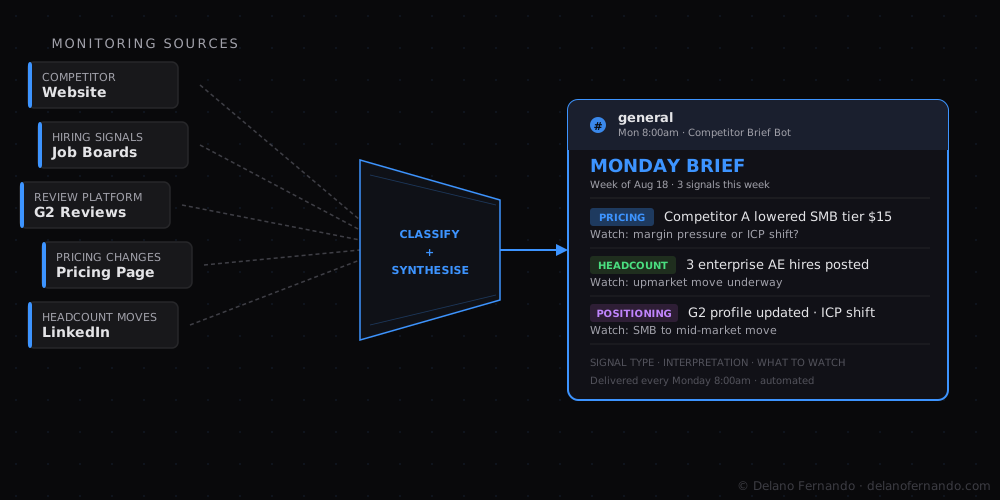
Automated Competitor Intelligence Digest

Problem

The GTM team was spending around 10 hours a week manually scanning competitor sites, review platforms, and job boards for pricing changes and positioning shifts. The output was inconsistent, always late, and rarely made it into a decision anyone could act on.

Solution

Built a scheduled intelligence system that scrapes 30+ sources, runs LLM-powered signal extraction, flags meaningful changes, and delivers a structured Slack digest every morning. The team reviews a single ranked summary instead of doing the research themselves.

Research time cut from 10 hrs/week to under 1 hr of review

Process flow

Scheduled crawl
Multi-source scrape
HTML → structured
AI classification
Relevance scoring
Delta detection
Curated digest

Judgment

Chose scheduled batch analysis over real-time streaming. Real-time would have cost 10× more in API calls and produced noise. A curated daily digest is more actionable than a firehose.

PythonPythonAIAIn8nn8nSlack APISlack APIPostgresPostgres

AI Automation·B2B SaaS company·Next.js·AI

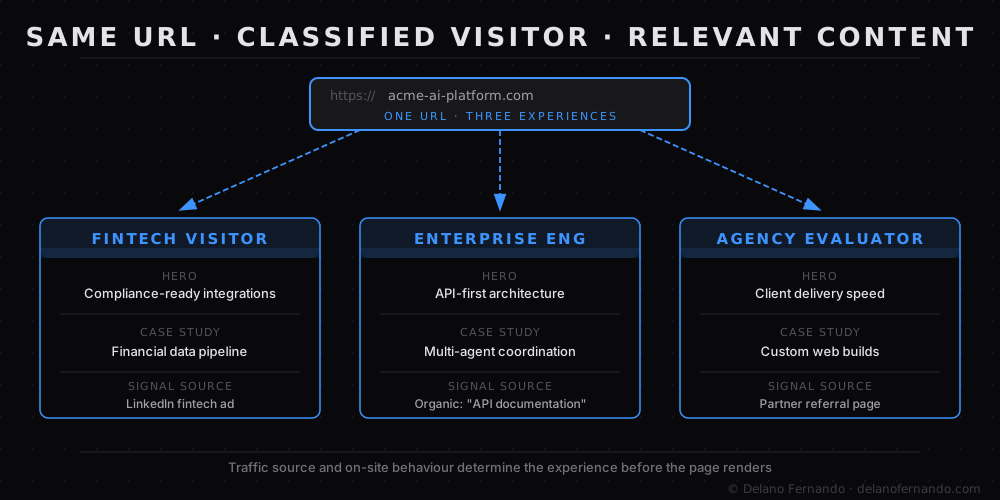
Behaviour-Driven Personalisation Engine

Problem

Every visitor to the site saw the same homepage regardless of industry, traffic source, or intent. The team was running A/B tests that took months to reach significance and never addressed the core issue: the content was too generic for any one segment to feel spoken to.

Solution

Led implementation of a rules-based dynamic content system that swaps hero copy, value proposition language, social proof, and CTA based on traffic source, referrer, and form enrichment data. No engineering dependency for new segments: the marketing team owns the rules.

8 audience segments live; marketing team adds new ones without engineering

Process flow

Behavioural signal
Lifecycle stage check
Engagement score
Content variant select
Send-time optimised
Attribution captured

Judgment

Chose explicit rules over ML-based personalisation: the dataset wasn't large enough for ML to outperform clear business logic, and rules are readable by the people who own the content.

Next.jsNext.jsAIAIHubSpotHubSpot

Data Architecture·Fintech startup·Salesforce·SFMC

Validated Financial Data Delivery Pipeline

Problem

A fintech startup was delivering portfolio data to clients through an API that was slow, occasionally wrong, and had no audit trail. Clients were catching errors before the team did. There was no way to demonstrate data provenance to regulators or enterprise buyers who asked.

Solution

Specified and led implementation of a validated data delivery pipeline with Salesforce and SFMC at its core: input validation at ingestion, checksums at delivery, structured error logging, and an append-only audit log per record. Deliveries went out via personalised email; each client received only data relevant to their portfolio, not a generic report.

Data errors now surface internally before clients see them; full audit trail on every record; personalised per-client email delivery

Process flow

Batch intake
Schema validation
Business rule checks
Personalisation merge
Checksum generated
SFMC render + deliver
Append-only audit

Judgment

Chose append-only audit logs over mutable records: financial compliance requires proof of what happened, not just the current state. Immutability is the only defensible position.

SalesforceSalesforceSFMCSFMCPostgreSQLPostgreSQLPythonPythonDockerDocker

AI Automation·SaaS company·AI·HubSpot

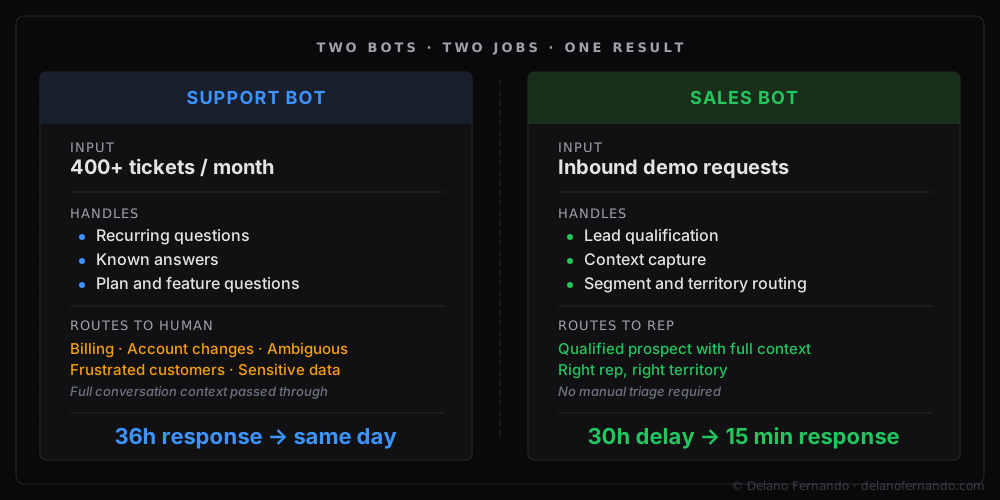
AI-Powered Support & Sales Bots

Problem

A support team handling 400+ monthly tickets was responding in 36 hours on average, mostly to the same recurring questions. Separately, inbound demo requests were sitting for a day or more before a rep picked them up, and the warmest leads had gone cold by then.

Solution

Configured an AI support flow connected to the knowledge base that handles tier-1 queries and escalates with full context. Added a qualification bot for inbound demos that collects use-case details, scores fit, and books calendar time — so reps only touch leads that are ready.

38% of tier-1 support handled without human touch; demo response time from 24 hrs to same day

Process flow

Inbound message
Channel + intent classify
KB lookup
AI-drafted response
Confidence gate
Escalate or send
CRM + transcript log

Judgment

Kept humans in the escalation path for anything above tier-1. Overbuilding the AI's authority would have required more trust infrastructure than the timeline allowed. Scoped correctly, it shipped and held.

AIAIHubSpotHubSpotn8nn8n

AI Automation·Series B B2B SaaS company·AI·Python

Signal-Based Company Prospect Intelligence Engine

12+Signal sources monitored
40-80Qualified companies / week
< 4 hoursSignal-to-CRM latency
12+ hrs / wkRep prospecting time saved

Problem

A high-velocity B2B sales team was building prospect lists manually using static databases that couldn't capture real-time market signals. Funding rounds, executive changes, technology migrations, and expansion announcements (the moments when a company is most likely to buy) went undetected until they surfaced in a newsletter days later. By the time a rep reached out, competitors had already booked the first meeting. Prospecting consumed over 12 hours per rep per week with no systematic way to prioritise who to contact first.

Solution

Built an autonomous company scouting engine that continuously monitors 12+ signal sources in parallel: news APIs, LinkedIn company activity, regulatory and funding databases, job board postings, and technology fingerprinting from public signals. A custom entity resolution layer clusters multiple signals about the same company before scoring begins, preventing duplicate noise and ensuring a funding announcement, three new engineering hires, and a product launch press release are all understood as a single high-intent company moment. A trained AI model — loaded with ICP criteria and domain knowledge bases, evaluates each resolved signal cluster and generates a brief rationale for every match. High-confidence prospects are automatically enriched and staged in the CRM with full signal provenance attached. Reps receive a ranked daily digest, no research required.

Process flow

Multi-source ingest
Entity resolution
ICP match scoring
AI evaluates ICP fit
Confidence threshold
CRM enrichment
Ranked rep digest

Judgment

Entity resolution was the critical architectural decision. Without a layer that understands multiple signals as being about the same company, you get a stream of disconnected noise instead of consolidated intelligence. The scouting quality is entirely a function of how well that resolution layer works. Everything else is execution.

AIAIPythonPythonn8nn8nHubSpotHubSpotPostgresPostgres

AI Automation·Growth-stage B2B tech company·AI·Python

Programmatic Content Engine for Technical SEO

200-400Pages generated / sprint
3 hrs → 8 minTime per page (vs manual)
3.2× in 6 monthsOrganic traffic growth
< 4% flaggedHuman revision rate

Problem

A B2B SaaS company with hundreds of addressable use cases, integrations, and target verticals needed search presence across long-tail queries without scaling a content team proportionally. Hand-written pages took three to four weeks per batch, couldn't keep pace with product changes, and the backlog grew faster than it was cleared. Competitors were ranking on queries where the product clearly had the better answer, simply because they had content and the company didn't.

Solution

Built a programmatic content engine: a structured schema maps every relevant combination of use case, integration, vertical, and feature. A trained AI model configured with brand guidelines, product knowledge bases, and internal linking rules generates page content from that schema. A validation pipeline checks each generation for factual alignment with the product database and brand guideline compliance before publishing. Pages below a confidence threshold are routed to a human editor with a diff view of what the AI produced vs. what the validator flagged. Approved pages are published directly to the CMS, submitted to the search index, and connected to the analytics stack. A change-detection layer refreshes pages automatically when underlying product data is updated.

Process flow

Schema + data layer
Template selection
AI drafts page
Accuracy validation
Human review gate
CMS publish
Index + track

Judgment

The structured data layer had to be built before configuring the AI generation layer. That was the non-negotiable. Without a clean, validated schema driving generation, AI content produces plausible-sounding pages that may be factually wrong about the product. The data layer is the moat. The generation is just execution on top of it.

AIAIPythonPythonn8nn8nNext.jsNext.jsPostgresPostgres

Web Builds·Multiple clients · Sri Lanka + international·Next.js·Astro

Custom Web Presence Builds

Problem

Businesses across consulting, finance, hospitality, and professional services were running on outdated sites, WordPress templates they couldn't modify, or no web presence at all. For international clients the problem was positioning — sites that looked generic in a market where first impressions determine whether a prospect reads further or bounces.

Solution

Designed and built custom sites for individual professionals, small businesses, and growing companies, from personal brand sites and portfolio pages to full product landing pages and event microsites. Each project started with a positioning conversation before any design decisions. Built on modern stacks for performance and maintainability, with clear handoffs so clients could manage content without touching code.

10+ custom sites shipped across Sri Lanka, UK, and Australia, averaging under 3 weeks from brief to live

Process flow

Positioning session
Information architecture
Design system
Component build
Perf + SEO audit
Deploy
Runbook handoff

Judgment

Treated every project as a conversion problem first, a design problem second. 'What does a visitor need to believe before they act?' consistently produced sites that outperformed the templates they replaced.

Next.jsNext.jsAstroAstroTailwind CSSTailwind CSSNode.jsNode.js

About

I sit between marketing, sales, and engineering. And I ship solutions.

Seven-plus years running marketing and revenue operations across global financial institutions, international brands, and high-growth tech. Today I lead Business Operations at a growth-stage AI company. Previously at Acuity Knowledge Partners and HSBC.

The work covers CRM architecture, automation engineering, AI workflow design, campaign execution, and the reporting that ties it together. Systems I have built support hundreds of thousands of contacts across multi-region teams, reducing manual ops work by 50 to 90 percent, improving conversion rates by 15 to 35 percent, and helping teams attribute millions in pipeline. I have also managed MarTech vendor relationships exceeding $200K.

I design the system, write the code, brief the team, and measure whether it moved the number. I have led cross-functional teams of 8 to 12 people across regions. My strength is operating where structure, clarity, and accountability matter. I deliver outcomes leaders can see.

Outside of client work I build for local and international clients, including Investography, a market intelligence platform for Sri Lankan retail investors, and automation, data, and AI systems across fintech, events, and SaaS.

FAQ

Common questions.

What does a MarOps System Audit include?+

A full-stack audit of your marketing and revenue operations: CRM architecture, automation logic, attribution, lifecycle stages, lead routing, and reporting. Delivered as a priority-scored fix list with flowcharts and a 60-minute walkthrough with your team. Fixed price, 2 weeks.

Do you work with early-stage or pre-revenue companies?+

Yes, if the problem is clearly defined. Early-stage companies benefit most from the AI Automation Build or One-Off Builds services. Audits work best when there is an existing stack to review.

How long does a typical engagement take?+

The MarOps Audit is 2 weeks. AI Automation Builds are 30 days, outcome-based. Advisory Retainers are monthly. One-Off Builds are scoped per project, typically 2 to 6 weeks.

What tech stacks do you work with?+

Primarily Salesforce, HubSpot, n8n, Python, Postgres, and modern web stacks. I also work with Slack, Outreach, LeanData, and most major MarTech tools. If you use something different, a discovery call will confirm fit.

Can you work alongside our existing team?+

Yes. All engagements are structured to transfer ownership cleanly. Every deliverable includes documentation so your team can run and extend the work without ongoing dependency.

Not answered here?Book a 30-minute call →

Contact

Have a problem worth solving?

30-min intro call, no pitch deck, no obligation. Tell me the messy version. I'll tell you if it's a fit and what a first move looks like.

Book a call →
Schedule a call