


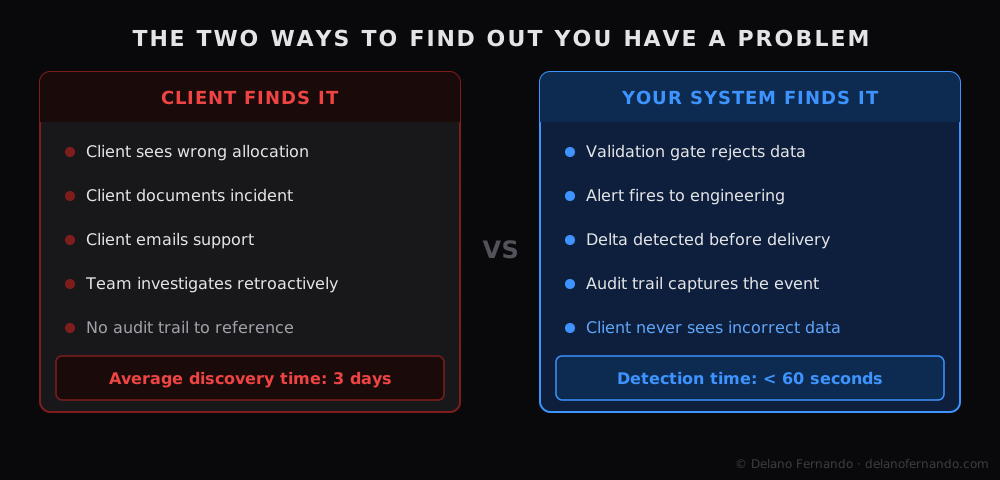
Clients were catching the errors. Not the team. By the time the team knew something was wrong, a client had already flagged it, worked around it, and documented the incident for their internal review. That is the worst-case monitoring setup: your clients are your QA team.
The problem was not that errors were happening. Errors happen. The problem was the discovery path. Every data quality failure was being surfaced by the person least equipped to investigate it and most likely to lose trust over it.
Why fintech data pipeline validation cannot be an afterthought
In financial data, a wrong number is not a UX problem. It is a compliance problem, a trust problem, and potentially a liability problem.
The instinct is to ship fast and validate later. In most software domains, that tradeoff is reasonable. In fintech data pipeline validation, it is not. When a client’s portfolio report shows incorrect allocations, that is not a bug report. That is the beginning of a trust conversation with a client who manages real money and answers to their own stakeholders.
The cost of finding a validation error before it reaches the client is low. The cost of finding it after is not just engineering time. It is the conversation, the documentation, the incident record, and the question the client does not ask out loud: if this happened once, how many times did I not notice?
There is also a second failure mode that is quieter: regulators and enterprise buyers will ask for data provenance (the documented record of where a piece of data came from and how it was transformed). A system built for speed rarely has this. The validation layer is where provenance gets built. Skip it, and you are not just shipping fast. You are shipping without the ability to explain yourself when it matters.
The audit trail problem
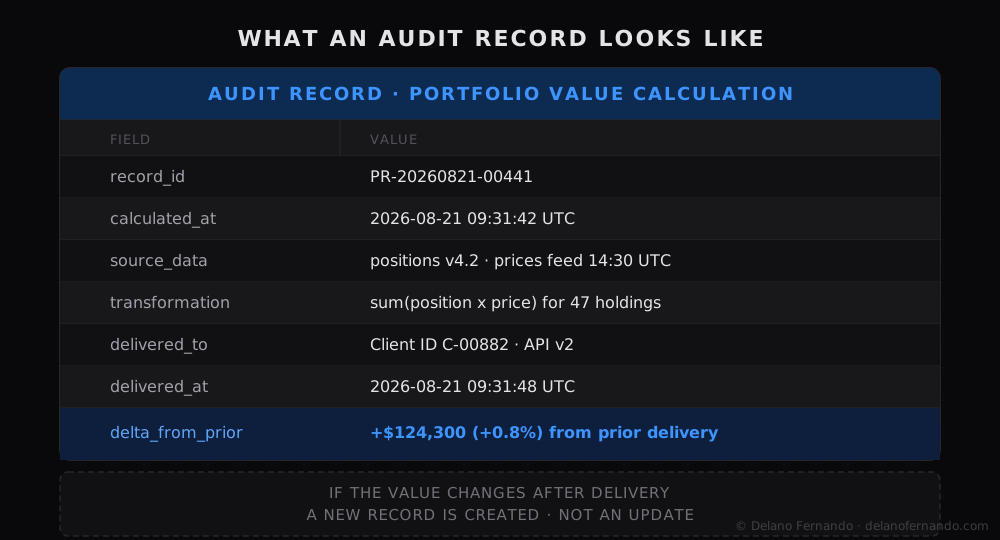
An audit trail in financial data is not a log file. A log file tells you that something happened. An audit trail tells you what the value was, where it came from, what source data was used to calculate it, and whether it has changed since the client last saw it.
Those are different questions. And for a regulator or an enterprise procurement team running due diligence, the second set of questions is the one that matters.
The problem with most financial data pipelines is that they were not designed with auditability as a first-class requirement. Data is ingested, transformed, aggregated, and delivered. The intermediate states are not preserved. If a value is wrong, you can see that it is wrong. You cannot always reconstruct why it was wrong, or confirm that the adjacent values were correct, or show that the error was isolated rather than systemic.
Rebuilding provenance retroactively is expensive and often impossible. The source data may have been updated since the error occurred. The transformation logic may have changed. The delivery timestamp may not have been recorded. You end up in a situation where you have a client with a documented incident and you have no comparable documentation to respond with.
What a validated pipeline actually involves
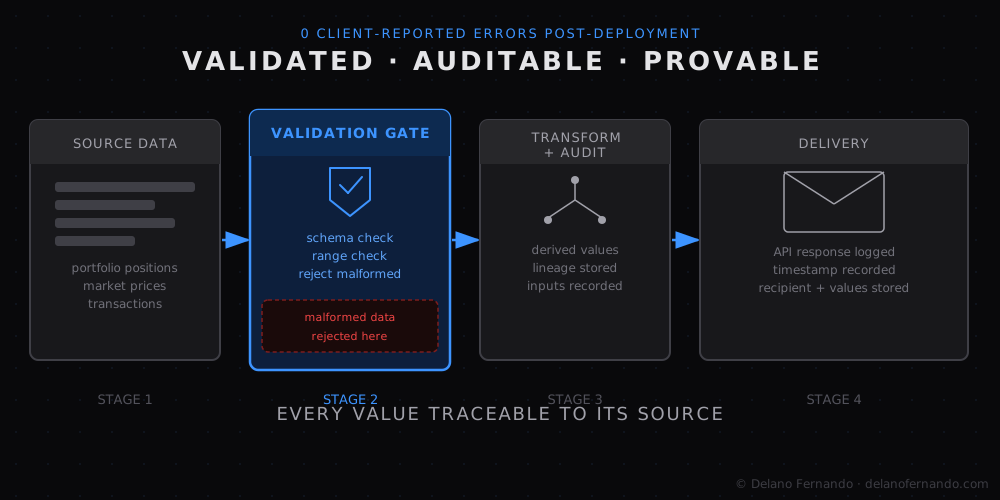
Validation is not a single step added at the end of a pipeline. It is a property of the pipeline’s architecture at every stage.
Schema validation (the check that incoming data matches the expected structure and value ranges) happens at ingestion. Malformed data gets rejected before it enters the system. This sounds obvious. In practice, most pipelines treat ingestion as a pass-through and push validation concerns downstream, where the cost of catching an error is higher.
Transformation auditing means that every derived value stores its calculation lineage. Not just the result, but the inputs and the version of the logic that produced it. When a portfolio value changes between deliveries, the system can show exactly what changed in the source data, which positions were affected, and by how much.
Delivery confirmation means the API response is not just sent. It is recorded: what was delivered, to which client, at what timestamp, and what the values were at the moment of delivery. If a value changes after delivery, there is a delta record, not an update. The prior state is preserved.
Change detection and notification complete the loop. When a material change in a delivered value is detected before the next scheduled delivery, there is a notification path that routes to the right person. The client does not find the discrepancy first.
Getting this right across a real-time portfolio data API involves more state management than most data pipeline designs anticipate. The validation layer adds latency if it is designed incorrectly, and insufficient coverage if it is designed for speed. The tension between those two failure modes is what most of the design work addresses.
The lesson
Fintech data pipelines fail at trust before they fail at speed. Clients can tolerate a slow API. They can escalate about it, ask for improvement timelines, and continue using the system while they wait. What they cannot tolerate is an incorrect API with no way to explain the discrepancy.
Build the audit trail into the schema design, not into the logging system. A log records that something happened. A schema that captures lineage at every stage makes it possible to prove what happened and why. Those are different capabilities, and only one of them holds up under regulatory review. The same principle applies to lead scoring in regulated environments: storing the score is not the same as storing enough to reconstruct the decision.
The earlier you build this, the cheaper it is. The later you build it, the more it costs, because you are rebuilding it around a pipeline that was not designed to support it.
The full technical detail is in the Validated Financial Data Delivery Pipeline case study. If your data pipeline has correctness gaps you cannot explain to clients or regulators, let’s talk.