


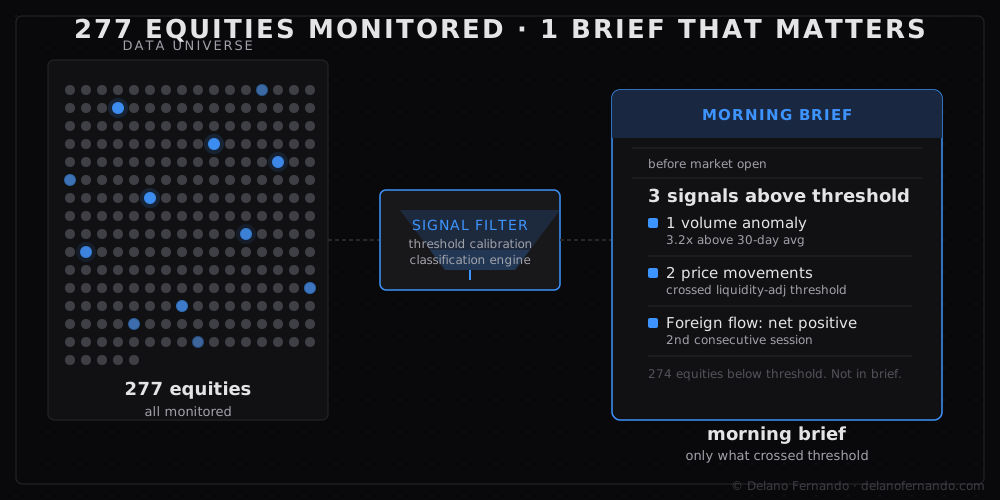
I built a stock market alert system for a frontier-market exchange with 277 listed equities. The first version monitored everything and alerted on all of it. It did not help. It just moved the noise from email to a notification.
The real problem turned out not to be data collection. It was the question of which data actually meant something.
Why a stock market alert system fails without a signal filter
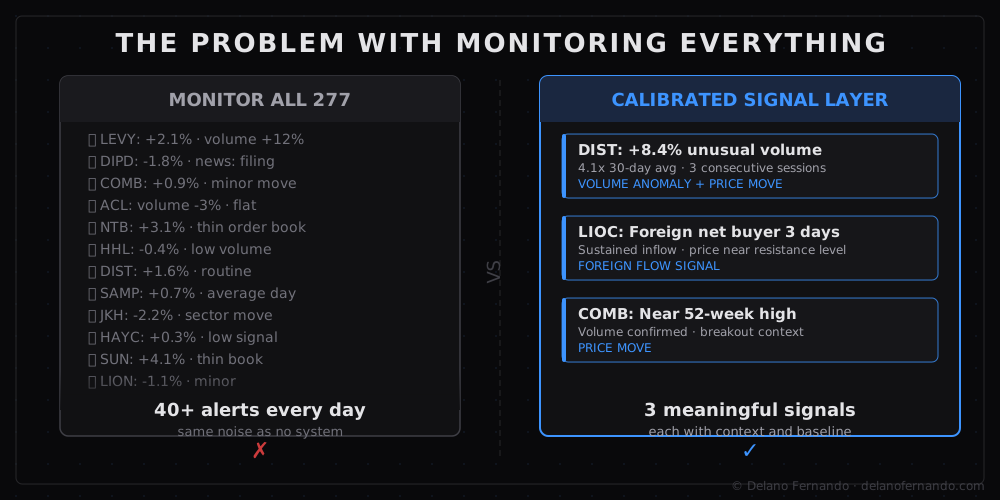
The logic behind monitoring everything feels sound. If you track every price move, every volume spike, every piece of market news, you will not miss anything. That is true. You also will not be able to act on anything, because you will be looking at 40 alerts every morning and cannot tell which three matter.
A stock market alert system without a signal filter is not a solution. It is a better-organised version of the original problem: manual review, just faster.
In a frontier market, this gets worse before it gets better. Liquidity (how easily a security can be bought or sold without affecting its price) varies dramatically across listings. A single transaction can move a price by 3%. That is not a signal. That is a thin order book (the live list of pending buy and sell orders) with one buyer. If your alert fires on every 3% move, you are alerting on microstructure noise, not meaningful market activity.
The threshold that separates signal from noise is not the same for every equity, and it is not fixed over time. Calibrating it was the first real design challenge.
The data problem in a frontier market
Frontier-market exchanges often have fragmented data infrastructure. Public portals exist, but they are inconsistent. Fields are formatted differently across sources. Prices are sometimes delayed. Corporate action data arrives in a broker email drop rather than a structured feed.
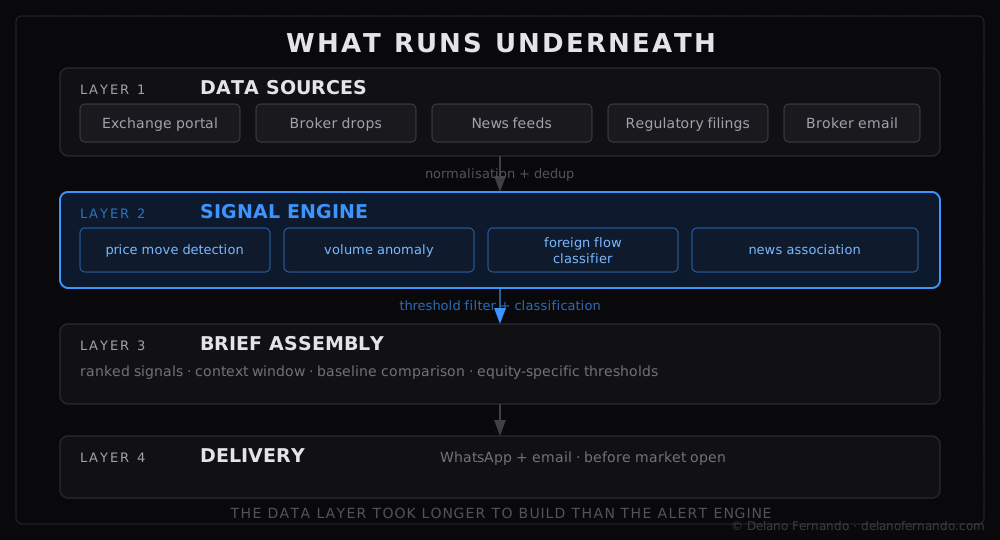
Before any alerting logic could run, the underlying data needed to be normalised. Different sources used different ticker formats. Historical price data had gaps. News items were sometimes associated with the wrong listing.
What runs underneath the alert logic is a normalisation layer that most people underestimate. It took longer to build than the alert engine itself. Every edge case in frontier-market data had to be handled explicitly, because there was no well-maintained upstream source to trust.
Market intelligence automation in this context is not just a pipeline problem. It is a data quality problem first, and the two are not separable.
What the platform actually does
At steady state, the platform monitors price movements, foreign investor flows (what international capital is buying and selling on a net basis), volume anomalies, and relevant news across all 277 listed equities. It runs before market open and produces a single morning brief.
The brief is short by design. It contains only the signals that crossed a calibrated threshold since the previous session. Each signal is classified by type: price move, volume anomaly, or flow shift. Each one is shown alongside its baseline, so the reader can see not just what moved but how that move compares to typical behaviour for that equity.
The classifier that sits between the raw data and the brief is where most of the design work lives. It determines whether a signal is meaningful or coincidental. That determination is different for a heavily traded equity near a 52-week high than for a thinly traded one with recent corporate news. The system runs through a coordinated set of checks that account for these differences without requiring a separate configuration per equity.
Building market intelligence automation that accounts for market context, not just raw price movement, is what separates a useful alert from one that trains you to ignore it.
The lesson
A stock market alert system is not a monitoring problem. It is a filtering and classification problem.
The raw data is available. The question is always which data crosses the threshold from noise into signal, and that threshold is specific to the market, the asset, and the moment. Broader coverage does not help. Calibrated coverage does.
The platform that went from “alerts on everything” to “three signals that matter” was not a larger pipeline. It was a better-designed filter sitting between the same data and the same investor.
Retail investor tools for frontier markets are underdeveloped relative to the complexity of operating in those markets. That gap is where this platform sits. The signal-filtering and entity-resolution challenges here share a common design pattern with AI-driven company scouting: the raw data is available to everyone, and the advantage comes entirely from what sits between the data and the decision.
The full build is in the Market Intelligence Alert Platform case study. If you are building something similar for your own context, let’s talk.